
Missionary countdown
LDS Missionary Countdown
Days served, days remaining and how far through the mission they are — kept current automatically and shared with everyone following the missionary, so the whole family is working from the same numbers.
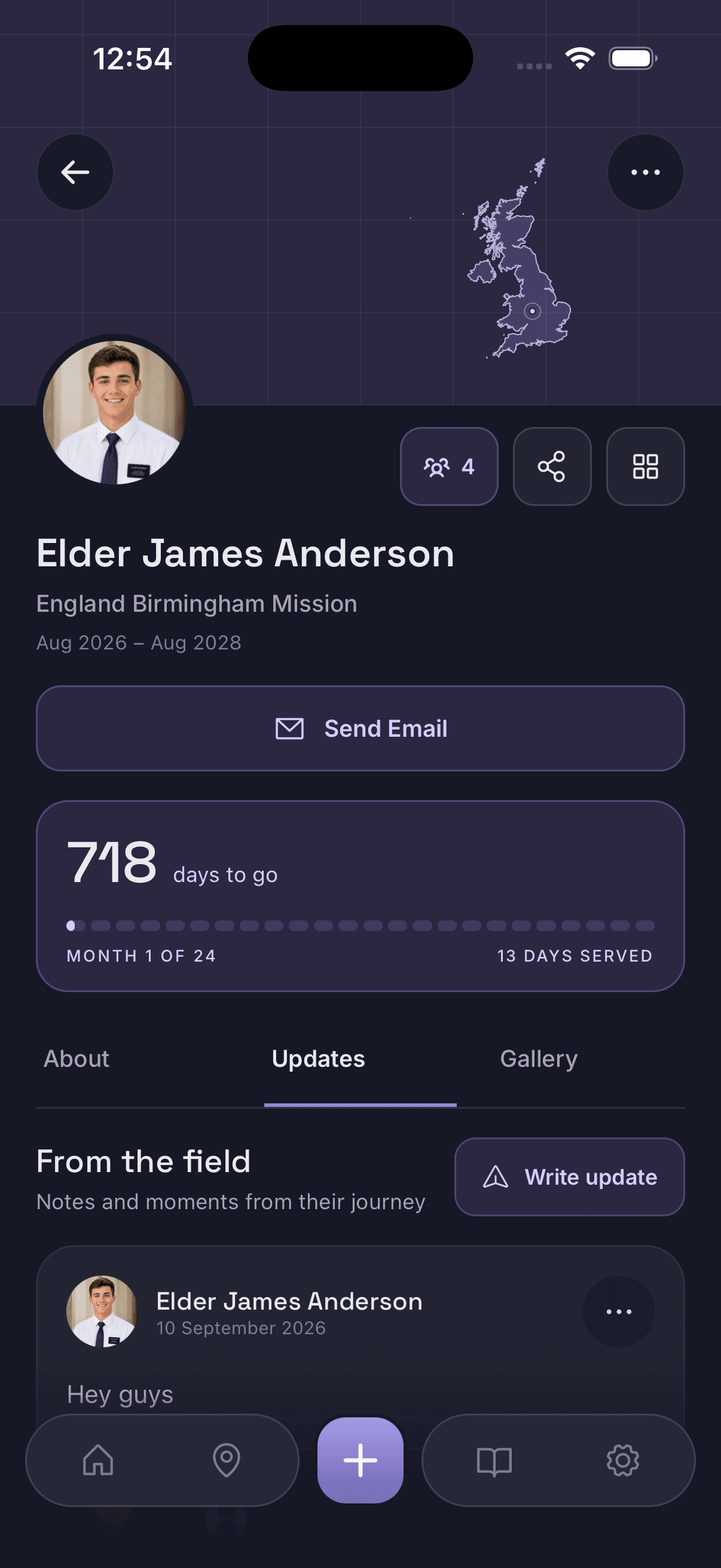
What a missionary countdown actually shows
A missionary countdown turns two dates into something a family can read at a glance. The first date is the day the missionary entered the field. The second is their expected release date. Everything else — days served, days remaining, percentage complete — comes from the distance between them.
In Missionary Tracker those numbers live on a card called Time in the Field at the top of every missionary profile. A progress bar runs across the top, with the raw count underneath: day 412 of 730, for example, and 56% beside it. Below that sit the two dates the whole thing is built from, labelled Entered Field and Expected Release, plus a plain-language line — one day closer to home, 318 days remaining.
The reason to keep it in an app rather than on a calendar is that nothing needs maintaining. Nobody recounts anything, nobody updates a spreadsheet, and the number a grandparent sees is the same number a sibling at university sees.
The four numbers families watch
Mission start date
The day they entered the field. Everything in the countdown is measured from here, so it is worth getting right when you create the profile.
Expected release date
The date they are currently expected to come home. It can be edited later if the mission office adjusts it.
Days served & remaining
The two counts that move every day — how much of the mission is behind them, and how much is still ahead.
Percentage complete
Days served as a share of the whole mission, shown as a percentage and a progress bar.
Milestones worth marking
Most families end up watching for the same handful of moments, and a progress bar makes them easy to spot coming:
- The first month. Usually the hardest stretch for everyone, and the first real proof that the mission is underway.
- Six months in. Language, area and routine have normally settled by now.
- The halfway point. The day days remaining drops below days served — the one families tend to celebrate loudest.
- One year left. A round, encouraging number on a long mission.
- The last transfer. The final stretch, when the countdown starts being read in weeks.
None of these need to be tracked by hand. They are simply where the numbers land, and having them visible to everyone following the profile means nobody misses one.
Why families like watching progress
A mission is long, and for the people at home it is mostly measured in the gap between letters. A countdown gives that time a shape. It is a small, concrete thing to look at on a day when you miss them, and it reframes a two-year absence as something with a visible end.
It also settles arguments. “How long has he got left?” is the most-asked question in an extended family with a missionary out, and when everyone is reading the same profile, everyone gives the same answer.
If you want to see the numbers for your own missionary before downloading anything, the missionary countdown calculator does the same maths in your browser — and will generate a shareable mission countdown card you can send to the family.
Prefer a Countdown You Can Color In?
Create a personalized missionary countdown map with one numbered square for every day of the mission. Download it free as a print-ready PDF and color in one square each day.
Create a Free Countdown MapThe countdown is one part of the profile
The same profile that holds the countdown also holds where they are serving and what they have shared. The missionary map puts their area on the globe alongside every other missionary you follow, and the Updates tab keeps missionary updates in one timeline for the whole family. Sharing the join code once means nobody has to be told the dates twice.
For a wider tour of what the app does, see the full feature overview, or start from the Missionary Tracker home page.
Missionary countdown questions
How is a missionary countdown calculated?
It is the span between the day a missionary entered the field and their expected release date. Days served is how many days have passed since the entry date, days remaining is how many are left until the release date, and the percentage complete is days served divided by the total length of the mission.
How long is an LDS mission?
Mission lengths differ by assignment. Full-time missions are commonly around 24 months for elders and 18 months for sisters, and senior couple missions vary in length. Because of that, Missionary Tracker works from the two dates on the profile rather than assuming a fixed duration.
What happens if the release date changes?
Dates do move. Edit the expected release date on the profile and the countdown, progress bar and percentage recalculate from the new date for everyone following that missionary.
Do I need the app to see a countdown?
No. The countdown calculator on this site works out days served, days remaining and percentage complete in your browser. The app is what keeps those numbers updating on their own and shared with everyone following the missionary.
Track their mission automatically
Add the two dates once and let the countdown, progress and milestones update themselves for everyone following along.
Free to download on iPhone and Android.